East of Eden

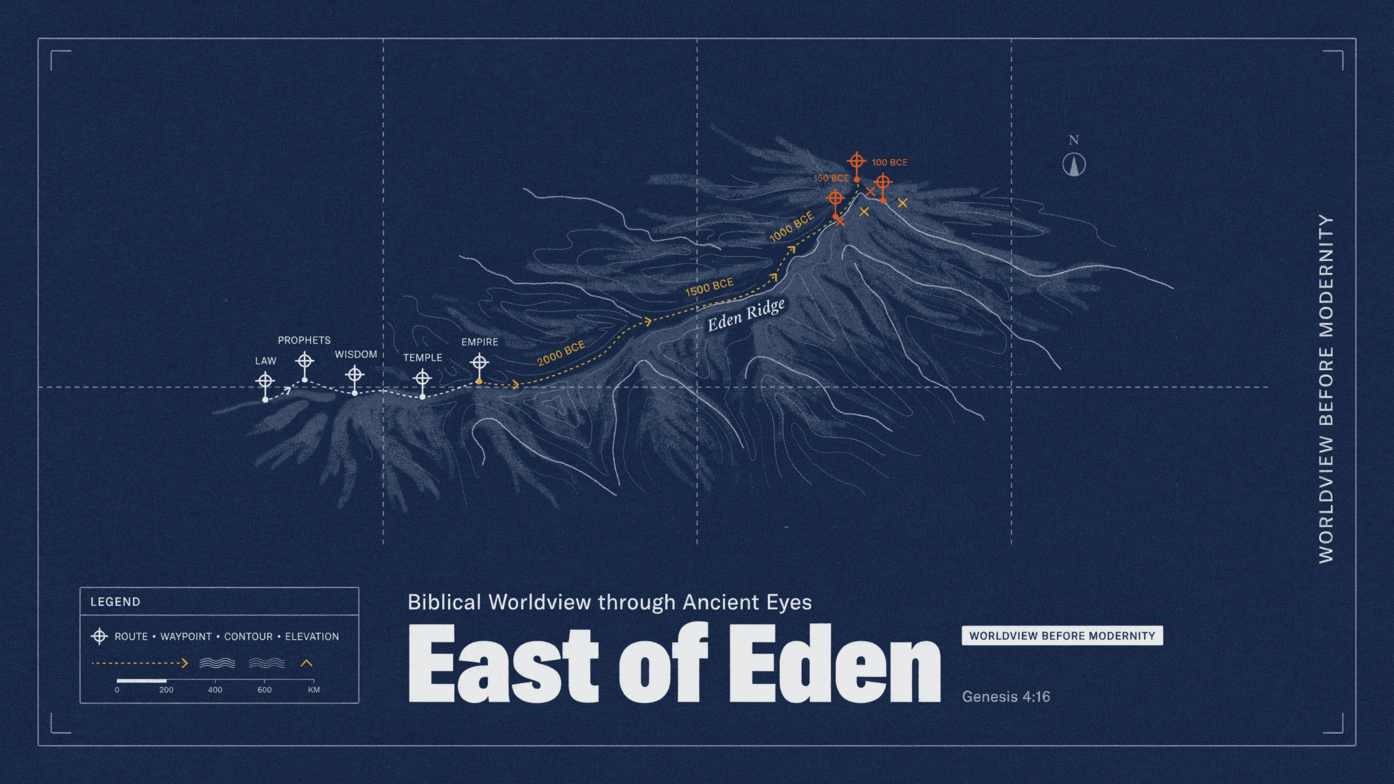
East of Eden: Ancient History, Fallen Gods, and What the Bible Really Says About Our World
The story of humanity's exile from the Garden of Eden is more than a moral lesson. It is the opening chapter of a long war between God and the fallen realm, one that echoes through ancient cities, pagan myths, and even modern culture in ways most people never notice.
What Happened After Adam and Eve Were Expelled from Eden?
When God drove Adam and Eve out of the Garden, He placed a cherubim and a flaming sword at its entrance to guard the way to the tree of life. As Genesis 3:24 records, "He drove out the man, and at the east of the garden of Eden he placed the cherubim and a flaming sword that turned every way to guard the way to the tree of life." (Genesis 3:24, ESV)
The weight of that moment is hard to overstate. They had not only brought the curse upon themselves. They had condemned every generation that would follow them to live separated from God. That is the crushing reality behind the expulsion.
Then in Genesis 4:16, we read: "Then Cain went away from the presence of the Lord and settled in the land of Nod, east of Eden." (Genesis 4:16, ESV) This eastward movement is where the story of human civilization truly begins.
Who Did Cain Marry? A Question Worth Answering Carefully
One of the most common objections raised against the Bible is the question of who Cain married. Many Christians reflexively answer that He married His sister, but that answer creates serious theological problems. God's character does not change. He expressed clear opposition to incest in Leviticus, and nowhere in scripture does it say Cain married a sibling.
There are actually three possibilities worth considering. First, God may have created other people outside the garden, which finds some support in Genesis 1 where He created male and female before the specific account of Adam and Eve. Second, He may have created additional individuals separately. Third, Cain may have married a sister. All three are speculative, but the first option at least preserves God's holiness without requiring us to contradict His own stated values.
The honest answer is simply: we do not know. And saying so is far better than speaking with false authority on something scripture does not address.
Where Did Human Civilization Begin? What Archaeology Tells Us
There is broad scholarly consensus that human civilization emerged in the Fertile Crescent, the land between the Tigris and Euphrates rivers, somewhere around 10,000 BC. Agriculture, cities, writing, trade, and organized religion all developed in an arc stretching from Egypt through the Levant into Mesopotamia.
The oldest city archaeologists have identified is called Eridu, located in southeastern Iraq. The Sumerians themselves remembered Eridu as the first city. It was founded around 5,400 BC and featured large temples, irrigation systems, and a complex social structure.
What makes Eridu remarkable from a biblical perspective is a series of connections that are difficult to dismiss as coincidence.
Is There a Connection Between the Bible and the World's Oldest City?
The Sumerian King List, dated to around 2100 BC, records that after kingship descended from heaven, the first king of Eridu was a man named Alulim. In Sumerian, Alulim means "fourth man."
Now consider the biblical genealogy. Adam was first. Cain was second. Enoch, Cain's son, was third. Irad, Enoch's son, was fourth. The name Irad and the name Eridu share the same basic consonants, which matters because ancient Hebrew was written without vowels.
This is speculative, but it is plausible in a way that is worth sitting with. The oldest city on earth, with the oldest major temple structure in Mesopotamia, had a first king called "the fourth man," and the city's name closely resembles the name of Adam's great-grandson. That is at minimum a fascinating convergence.
How Did Pagan Gods Distort the Truth About the God of the Bible?
The patron God of Eridu was Enki, known to the Babylonians as Ea. He was depicted as the God of sweet waters, shown with two streams flowing from His shoulders representing the Tigris and Euphrates rivers. He was considered the source of life-giving water.
Jesus said in John 4:14, "Whoever drinks of the water that I will give Him will never be thirsty again. The water that I will give him will become in him a spring of water welling up to eternal life." (John 4:14, ESV)
The pattern is consistent throughout ancient mythology. The fallen realm does not create. It imitates and distorts. The Babylonian creation myth, the Enuma Elish, describes the God Marduk defeating a chaos goddess named Tiamat. The Hebrew word for the deep in Genesis 1:2, the formless void over which the Spirit of God hovered, is closely related to that same name. The pagan version simply replaced God with a false deity and claimed credit for His work.
What Were People in the Ancient Near East Actually Worshiping?
At Eridu and surrounding sites, archaeologists have uncovered strange figurines called Ubaid lizardmen. These serpentine figures stand upright, have elongated cone-shaped heads, and include female versions nursing infants. No reptile in the natural world nurses its young. These figures are not natural. They are representations of something else entirely.
Additionally, over 200 sets of human remains from the Ubaid culture show deliberate cranial deformation, skulls shaped to appear elongated and serpentine. This practice appeared across the region from roughly 7,500 BC to 4,000 BC and then largely disappeared. Someone was shaping infants' skulls to resemble something. The most reasonable explanation, given the biblical account of the serpent in the garden, is that people were trying to imitate or honor a being they had encountered or been told about.
What Does the Tower of Babel Actually Teach Us?
The Tower of Babel is often taught as a lesson about human pride. But that misses the deeper point. The Akkadian word Babalu means "gate of the gods." This was not simply a monument to human ambition. It was an attempt to open a doorway to the divine realm on human terms, apart from God.
Eridu was eventually completely abandoned. Genesis 11 records that the people at Babel were scattered and the city was left. The geographic and historical overlap between these two accounts is striking. When God scattered the nations, He was not simply punishing pride. He was dismantling a system of false worship and supernatural rebellion.
Deuteronomy 32:8 says, "When the Most High gave to the nations their inheritance, when he divided mankind, he fixed the borders of the peoples according to the number of the sons of God." (Deuteronomy 32:8, ESV) The supernatural dimension of this story is not incidental. It is central.
Is There a 5,000-Year-Old Goddess Behind Modern Gender Ideology?
One of the most striking connections between ancient paganism and contemporary culture involves a goddess known by many names. In Sumer she was called Inanna. In Babylon, Ishtar. In Canaan, Ashtar. In Greece, Aphrodite. In Rome, Venus.
Inanna was the goddess of sex and war. She was explicitly androgynous, sometimes depicted with a beard, sometimes without. Her cult followers included eunuchs and transvestites. Ancient hymns attributed to her worship include lines where her followers sing that she turns a man into a woman and a woman into a man, adorning each as the other.
This is not a new idea. It is a 5,000-year-old religious practice. When churches celebrate or affirm gender-bending ideology without understanding its roots, they are unknowingly accommodating the worship of a pagan deity. The people participating may not know that. But ignorance does not change what it is.
Her first recorded title was Queen of Heaven. That same title has been applied in some Christian traditions to Mary, the mother of Jesus. The title itself originates in ancient paganism and should give us pause.
Why Does Any of This Matter for Christians Today?
Scripture is not isolated from the ancient world. It is embedded in it. The Bible addresses the same cultures, the same cities, and the same spiritual forces that show up in archaeology and ancient literature. When people say there is no evidence for the biblical account, the honest response is that the evidence is there. It simply requires knowing where to look and how to read it.
Jesus told His disciples in Matthew 20:25-26, "You know that the rulers of the Gentiles Lord it over them, and their great ones exercise authority over them. It shall not be so among you." (Matthew 20:25-26, ESV) God never designed humanity to dominate one another. He designed us to work, to tend, to help, and to depend on Him. Every system that concentrates power in the hands of a few and controls the many through dependency is a very old pattern, one that traces back to the earliest cities of Mesopotamia.
The long war between God and the fallen realm did not begin in the New Testament. It began in the garden. And it is still being fought today, often in ways we do not recognize because we have not done the work of understanding where these ideas come from.
Life Application
This week, take time to look more carefully at the cultural ideas and movements around you and ask where they actually come from. The enemy does not create. He imitates, distorts, and repackages. When something in culture is celebrated as new and progressive, it is worth asking whether it is actually ancient and regressive.
Ask yourself these questions:
- Are there ideas or cultural trends I have accepted without examining their spiritual roots?
- Do I know the Bible well enough to recognize when something contradicts it, even when it is dressed in compassionate or modern language?
- Am I willing to engage curious or skeptical people by pointing to the historical credibility of scripture, rather than only asking them to take it on faith?
- Where in my own life am I depending on systems or institutions rather than on God as my provider and authority?
The connections between ancient history and scripture are real. They are discoverable. And they are one of the most powerful tools available for helping people who are skeptical of Christianity take a second look at the Word of God. Know your Bible. Know your history. And do not be surprised when they point to the same truth.